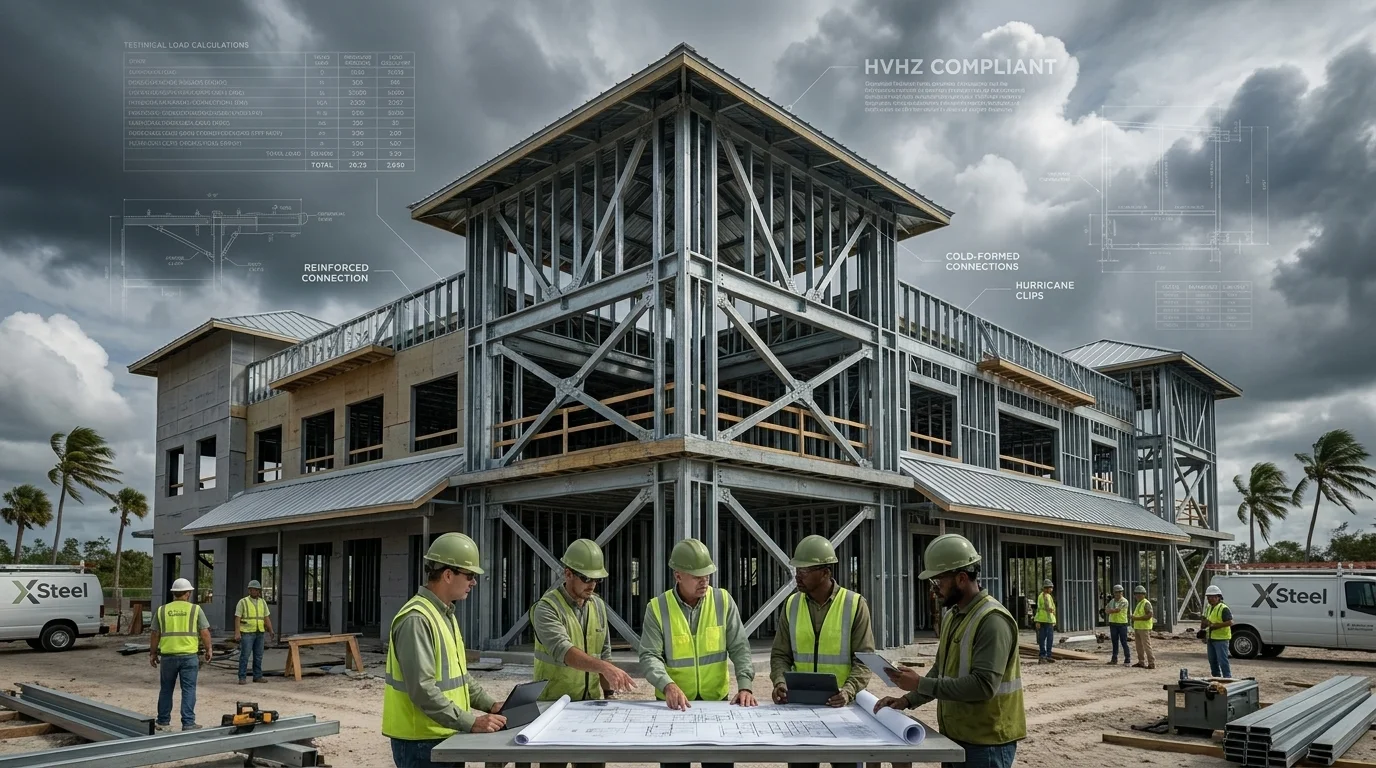
Florida’s construction environment is among the most demanding in the United States. The Florida Building Code (FBC) incorporates stringent structural requirements reflecting the state’s significant exposure to hurricanes, extreme high winds, and other environmental risks. Within this already demanding regulatory framework, the High Velocity Hurricane Zone (HVHZ) — covering Miami-Dade and Broward Counties — imposes even more rigorous structural and product requirements. For builders and developers working with cold-formed steel (CFS) framing in Florida, understanding and meeting these requirements is an absolute necessity.
Understanding the Florida Building Code
The Florida Building Code is a comprehensive regulatory framework governing the design, construction, and occupancy of all buildings throughout the state. It is based on the International Building Code (IBC) but incorporates Florida-specific amendments that address the state’s unique climate and risk profile. For structural CFS framing systems, the FBC references AISI engineering standards — particularly AISI S100, the North American Specification for the Design of Cold-Formed Steel Structural Members. Compliance with these referenced standards is a mandatory requirement for all CFS framing systems used in Florida construction.
What is HVHZ?
The High Velocity Hurricane Zone designation applies to Miami-Dade and Broward Counties, which face the most severe and consistent hurricane exposure in Florida. HVHZ requirements go significantly beyond the standard FBC provisions, imposing additional product approval, structural testing, and installation requirements for all building components, including structural framing systems. For CFS framing in HVHZ, products must have Florida Product Approval, connections must be designed to meet enhanced wind load requirements, and installation must comply with approved procedures and inspection protocols.

Life-Safety Requirements in Steel Construction
Life-safety codes govern the aspects of building design and construction that protect occupants in the event of an emergency — fire, structural failure, or other serious hazard. For CFS construction, life-safety requirements include fire rating requirements for wall, floor, and roof assemblies, structural redundancy provisions to prevent progressive collapse, and connection integrity under extreme loading conditions, including extreme wind and seismic events. Meeting these requirements in CFS construction requires careful engineering design and systematic coordination throughout the entire project.
How X Steel Frame Ensures Code Compliance
At X Steel Frame, code compliance is integrated into our engineering coordination process from the very earliest stages of every project. Our code-aware coordination approach means that HVHZ requirements, Florida Building Code provisions, and life-safety standards are considered in every design decision — not addressed as an afterthought at the end when problems are expensive to fix. Our team reviews structural designs against all applicable code requirements and develops coordination packages that incorporate fully code-compliant structural details and connection designs.

Avoiding Common Compliance Pitfalls
The most common code compliance problems in CFS construction arise from inadequate connection design that fails to account for all applicable load combinations, missing or incorrect Florida Product Approvals for structural components, failure to account for HVHZ-specific wind load requirements in the structural design, and assembly details that do not correctly achieve required fire ratings. X Steel Frame’s systematic approach to code compliance catches all of these issues before they reach the job site — saving significant time, money, and legal exposure for our clients.
Product Approval Management
In Florida’s regulatory environment, CFS structural components must have the appropriate Florida Product Approvals for the specific application and building code jurisdiction. Managing these approvals is a complex but essential part of the code compliance process. X Steel Frame’s coordination process systematically tracks all applicable product approval requirements — ensuring that every specified CFS component has the required approvals for its intended application and that all documentation is in order for building department submission and inspection.
Conclusion:
Meeting Florida Building Code and HVHZ requirements in steel construction requires specialized engineering expertise and systematic coordination discipline. X Steel Frame provides the code-aware engineering coordination that ensures your CFS project is designed, detailed, and built in full compliance with all applicable structural and life-safety standards — protecting your investment and your project’s occupants. Contact us to discuss your project’s specific code compliance requirements today.
