
Modern construction has evolved far beyond traditional building methods. Today’s commercial, residential, and modular developments demand precision, speed, technical coordination, and long-term structural reliability. As projects become more complex, Engineering Coordination has become one of the most important parts of successful Cold-Formed Steel (CFS) construction.
From BIM modeling and Design-Assist workflows to MEP integration and structural optimization, engineering coordination ensures that every component of a project works together before construction even begins. Instead of solving problems onsite, developers and contractors now rely on digital coordination to eliminate friction, reduce costly delays, and accelerate project delivery.
At X Steel Frame, engineering coordination is integrated directly into precision-led CFS workflows to create structurally optimized frameworks designed for Florida’s high-performance developments. Through BIM-integrated planning and Design-Assist collaboration, every project is engineered for dimensional certainty, faster assembly, and long-term resilience.
Understanding Engineering Coordination in CFS Construction
Engineering coordination is the process of aligning architectural design, structural systems, fabrication requirements, and MEP services into one unified construction workflow. In Cold-Formed Steel construction, this coordination process becomes even more important because steel framing systems are manufactured with extremely precise tolerances.
Every steel profile, opening, service route, and connection point must align perfectly before fabrication begins. Even small errors in coordination can create major problems during installation, affecting drywall systems, facade integration, modular stacking, or mechanical pathways.
This is why engineering coordination happens long before onsite assembly starts.
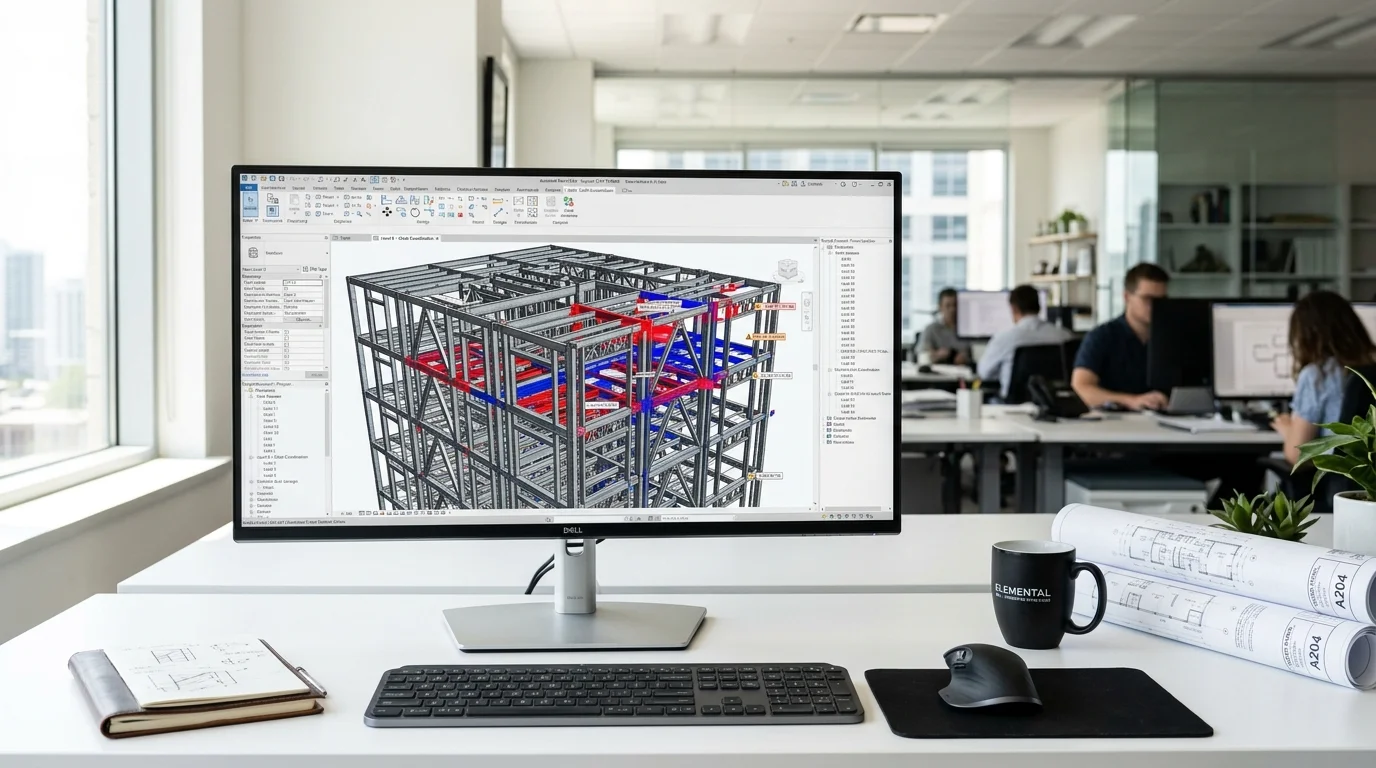
Using BIM-integrated workflows, project teams can create a digital twin of the structure where clashes and conflicts are identified early in the design phase. Structural systems, electrical layouts, plumbing pathways, HVAC systems, and architectural details are coordinated together to ensure seamless integration during field execution.
This engineering-led approach creates a smoother construction process while significantly reducing uncertainty throughout the project lifecycle.
Why Engineering Coordination Matters in Modern Construction
Modern construction projects involve multiple disciplines working simultaneously. Architects, structural engineers, MEP consultants, fabricators, and contractors all contribute to the same project, and without proper coordination, conflicts become unavoidable.
Traditional construction methods often rely on resolving these issues onsite, leading to:
- Schedule delays
- Cost overruns
- Material waste
- Field rework
- Trade clashes
- Installation errors
Engineering coordination eliminates these risks by solving problems digitally before fabrication and installation begin.
For CFS construction, this level of coordination is essential because precision-manufactured steel systems depend on exact alignment. A coordinated framework ensures every component fits correctly, reducing installation delays and improving overall structural quality.
This process becomes especially valuable in Florida developments where projects must meet strict wind-load requirements and High-Velocity Hurricane Zone (HVHZ) regulations. Engineering coordination ensures these structural standards are integrated directly into the framework during the digital planning phase.
The Role of BIM in Engineering Coordination
Building Information Modeling (BIM) has transformed the way modern construction projects are delivered. Instead of relying solely on 2D drawings, BIM creates an intelligent digital environment where all project systems are coordinated together.
In CFS construction, BIM allows engineers and project teams to optimize structural assemblies before fabrication starts.
Through BIM-integrated coordination, teams can:
- Detect structural clashes early
- Optimize MEP pathways
- Improve installation sequencing
- Validate code compliance
- Reduce onsite modifications
- Accelerate project timelines
This digital workflow improves communication between all disciplines while creating greater visibility throughout the project lifecycle.
At X Steel Frame, BIM coordination is integrated directly into Design-Assist workflows to ensure every cold-formed steel framework is optimized for precision assembly and long-term structural performance.

Design-Assist Coordination Improves Project Efficiency
One of the most effective approaches in modern CFS construction is Design-Assist coordination. Rather than waiting until the construction phase to solve technical challenges, Design-Assist collaboration brings engineers, fabricators, contractors, and designers together early in the project lifecycle.
This proactive approach improves constructability while reducing uncertainty before fabrication begins.
Design-Assist coordination helps developers achieve:
- Faster project delivery
- Improved cost control
- Better material efficiency
- Reduced change orders
- Improved trade coordination
- Greater structural certainty
For complex commercial, modular, and multi-family developments, Design-Assist workflows provide the technical leadership required to maintain precision throughout every stage of construction.
By resolving conflicts in the virtual environment instead of onsite, projects move faster with fewer disruptions and greater installation accuracy.

Why CFS Construction Depends on Precision Coordination
Cold-Formed Steel framing systems are fundamentally different from traditional building materials. Unlike timber framing, CFS systems are engineered for manufacturing-grade repeatability and dimensional accuracy.
This precision creates major advantages for modern construction, including:
- Faster assembly
- Better structural consistency
- Reduced material waste
- Improved durability
- Greater design flexibility
- Enhanced multi-trade integration
However, these advantages can only be achieved through accurate engineering coordination.
Because CFS systems are manufactured to exact specifications, every opening, service route, and connection detail must be coordinated before production. This is especially important for projects involving:
- Modular construction
- Curtain wall systems
- Mid-rise developments
- Hospitality projects
- Interior drywall framing
- Multi-family structures
Without proper coordination, even small alignment issues can impact project timelines and installation quality.
Engineering-led coordination ensures that cold-formed steel systems maintain the dimensional precision required for high-performance construction.
Engineering Coordination Supports Faster Construction
Speed has become one of the biggest priorities in modern development. Delays increase project costs, impact occupancy schedules, and slow overall capital velocity.
Engineering coordination helps accelerate construction by creating predictable workflows from digital design to field assembly.
With coordinated CFS systems, developers can reduce reliance on onsite problem-solving while streamlining installation processes for multiple trades simultaneously.
Pre-coordinated openings, integrated service pathways, and clash-free assemblies allow teams to move faster without sacrificing structural quality.
This industrialized approach to construction is particularly valuable in Florida’s competitive commercial and residential markets where project timelines directly impact profitability and operational efficiency.
Long-Term Structural Performance and Durability
Engineering coordination is not only about speed and efficiency — it also improves long-term structural performance.
Cold-formed steel systems offer significant advantages over traditional wood framing, especially in high-humidity coastal environments like Florida.
CFS frameworks are:
- Resistant to mold and rot
- Immune to termites and pests
- Non-combustible
- Structurally stable
- Engineered for wind resistance
- Designed for long-term dimensional accuracy
By integrating engineering coordination into the design phase, project teams ensure these structural advantages are fully optimized throughout the building lifecycle.
This creates durable, future-ready developments capable of maintaining performance under demanding environmental conditions.
The Future of Engineering Coordination in Construction
As construction continues shifting toward industrialized building systems, engineering coordination will become even more important.
Modern projects now demand:
- Faster delivery
- Greater precision
- Reduced waste
- Improved sustainability
- Better digital integration
- Smarter workflows
Engineering coordination provides the foundation for achieving these goals.
Through BIM technology, Design-Assist collaboration, and precision-engineered CFS systems, developers can eliminate traditional construction inefficiencies while creating structures optimized for speed, resilience, and long-term value.
The future of high-performance construction will rely heavily on coordinated digital workflows that connect design, fabrication, and field assembly into one streamlined process.
Ready to Optimize Your CFS Project?
Partner with X Steel Frame Engineering Coordination Services for precision-led BIM coordination, Design-Assist workflows, and high-performance cold-formed steel structural systems tailored for modern Florida construction projects.
