
Cold-formed steel (CFS) is one of the most important structural materials in modern construction, yet many developers and contractors are still unfamiliar with its full capabilities and applications. This comprehensive guide covers everything you need to know about CFS — what it is, how it is manufactured, where it performs best, and why it is becoming the structural material of choice for commercial and mid-rise construction throughout Florida and beyond.
What is Cold-Formed Steel?
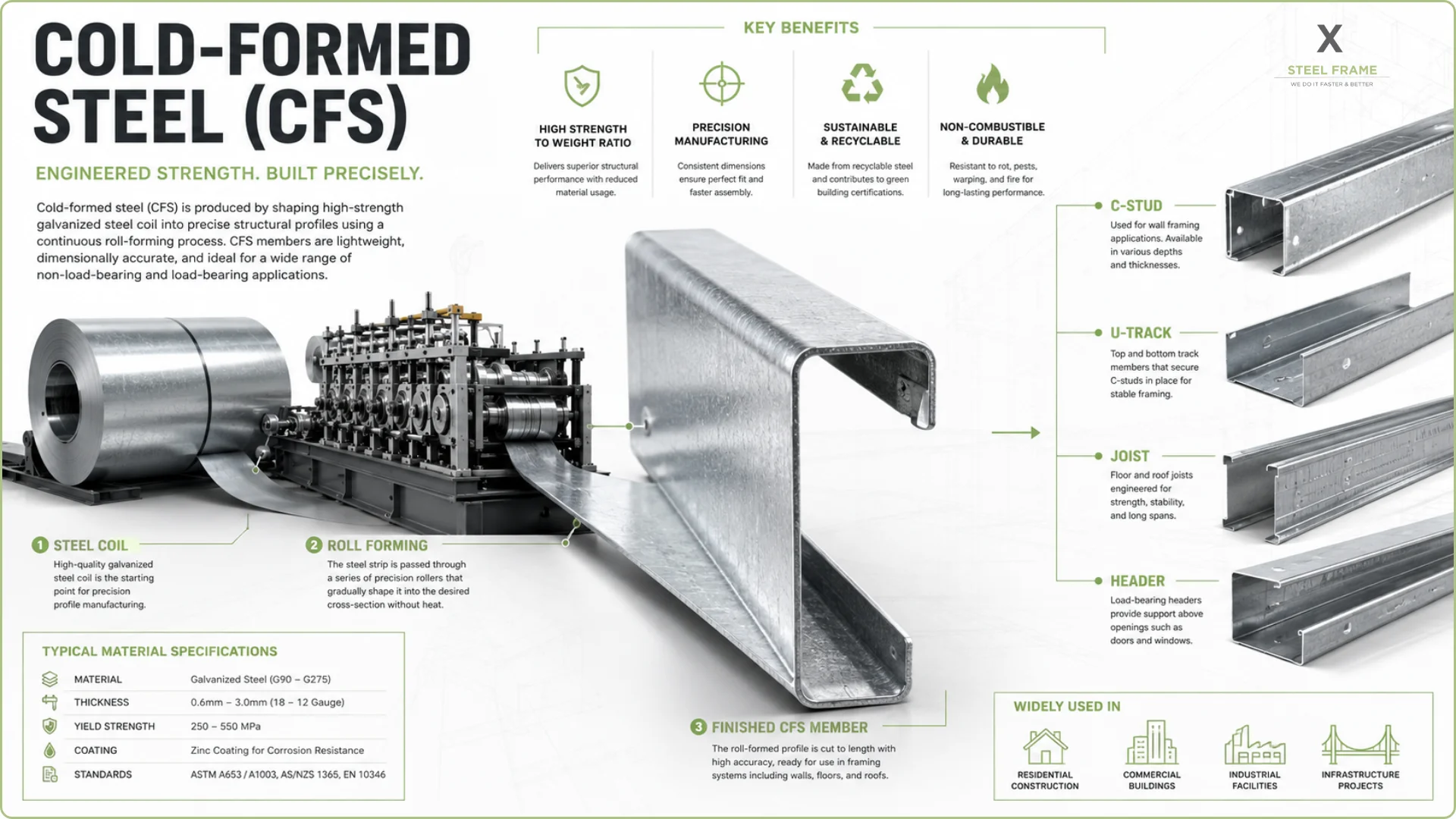
Cold-formed steel refers to steel that is shaped at room temperature by rolling or pressing thin sheets of steel coil into structural profiles. Unlike hot-rolled steel, which is formed at high temperatures and used for heavy structural sections such as wide-flange beams and columns in tall buildings, CFS uses thinner gauges processed at ambient temperatures. The result is a lightweight, high-strength structural product that can be manufactured into a wide variety of shapes — studs, tracks, joists, headers, angles, and custom profiles.
How is Cold-Formed Steel Made?
The manufacturing process for CFS begins with coils of flat steel sheet. These coils are fed through a roll-forming machine, which progressively bends the sheet into the desired profile shape. The process is fast, precise, and highly automated — allowing manufacturers to produce large quantities of consistent, dimensionally accurate structural members. Most CFS members used in construction are made from galvanized steel, which provides excellent corrosion resistance without the need for additional surface treatments throughout the product’s service life.
Common CFS Profiles and Applications
The most common CFS profiles in construction include C-shaped studs and joists, U-shaped tracks, L-shaped angles and clips, and Z-shaped bridging members. These profiles are used to construct load-bearing walls, non-load-bearing interior partitions, floor and roof systems, facade subframes, and high-precision interior drywall framing systems. The versatility of cold-formed steel profiles makes it suitable for virtually every structural application in mid-rise and commercial construction.

CFS Structural Performance
Cold-formed steel achieves impressive structural performance for its weight. The section properties of CFS members — including moment of inertia and section modulus — are well-documented in engineering standards such as AISI S100, the North American Specification for the Design of Cold-Formed Steel Structural Members. This allows structural engineers to design CFS systems with complete confidence, knowing exactly how each member will perform under every applicable load condition and combination.
CFS vs. Hot-Rolled Steel
Hot-rolled steel is used for heavy structural applications — skyscrapers, bridges, and large industrial facilities. Cold-formed steel is used for lighter structural applications in mid-rise, commercial, and residential construction. CFS is thinner, lighter, and more economical for the load ranges typical in these building types. It is also easier to handle on-site and does not require welding for most connections — screws and mechanical clips are typically used instead, which speeds up installation significantly.

Why Builders Choose CFS
Builders and developers choose cold-formed steel for its consistent factory quality, excellent fire resistance, complete pest resistance, dimensional accuracy, and seamless compatibility with engineered design processes. CFS also integrates naturally with modular and panelized construction methods — making it ideal for the faster, more efficient building approaches that the industry is rapidly moving toward across all building types and market segments.
Engineering Coordination for CFS Projects
Maximizing the benefits of cold-formed steel requires expert engineering coordination. The design of CFS systems involves detailed analysis of load paths, connection details, deflection limits, and code compliance requirements. At X Steel Frame, we provide comprehensive engineering coordination for CFS projects of all scales — ensuring that your structural system is designed for performance, buildability, and full Florida Building Code compliance.
Conclusion
Cold-formed steel is a versatile, high-performance structural material that is rapidly becoming the preferred choice for modern construction. Understanding its properties, applications, and engineering requirements is essential for anyone involved in CFS construction today. Partner with X Steel Frame to access the specialized engineering expertise and coordination services that ensure your CFS project is delivered with precision and total confidence.
