
Few developments in the construction industry over the past decade have been as significant or as far-reaching as the rise of modular construction. What began as a niche approach — limited to specific building types and geographic markets — has rapidly expanded into a mainstream construction methodology reshaping how developers, contractors, and engineers approach building projects of all scales and levels of complexity.
The Scale of the Transformation
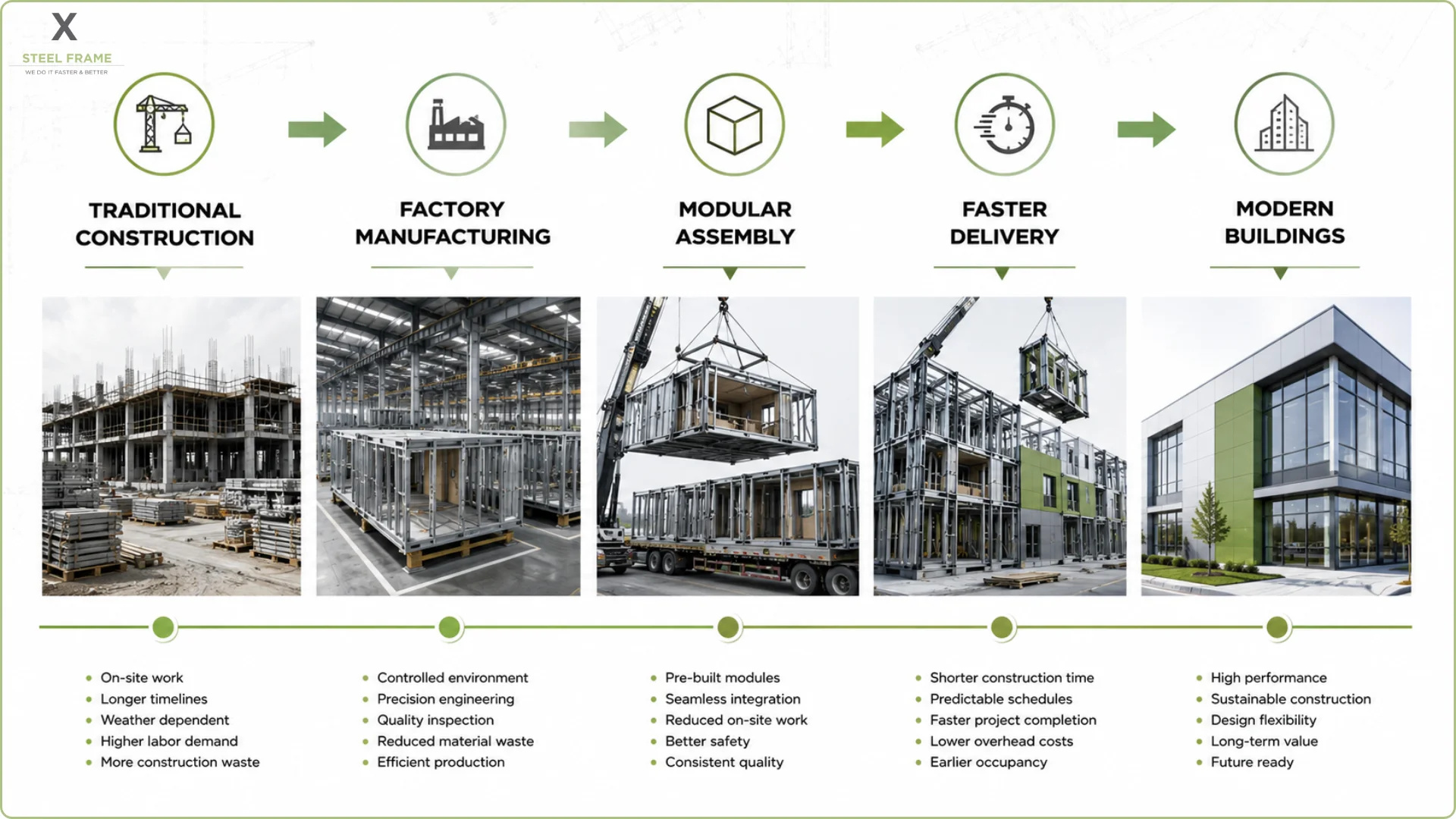
Modular construction has grown from a very small percentage of total construction output to a significant and growing market segment across multiple sectors — multi-family residential, hospitality, student housing, healthcare, and commercial construction. This growth has been driven by a powerful convergence of factors: increasing construction material costs, growing skilled labor shortages, tighter project delivery schedules, and substantial advances in digital engineering that make off-site production more precise and economically efficient than ever before.
What is Driving the Transformation?
Several powerful industry forces are accelerating the adoption of modular construction. Labor shortages are among the most significant drivers — skilled construction labor is increasingly scarce and expensive in most markets. Modular construction reduces reliance on on-site skilled labor by shifting production to factory environments where work is organized more efficiently. Schedule pressure is another major factor — developers who need to deliver projects faster are turning to modular approaches to compress timelines.
Quality Demands and Technology Enablement
Quality expectations from building owners and occupants continue to rise above what conventional on-site construction can consistently deliver. Factory production environments provide the controlled quality inspection and correction processes that result in more consistently high-quality outcomes. Technology has simultaneously made modular production more precise than ever — BIM modeling, digital coordination, and advanced manufacturing equipment allow modular factories to produce components with extremely high accuracy at competitive cost.

Steel Framing as the Backbone of Modular Construction
Cold-formed steel (CFS) framing is the structural material that makes modern modular construction technically viable and economically practical. Its dimensional precision, relatively light weight, and perfectly consistent material properties make it ideal for factory production environments. CFS modular structures can be engineered to precise tolerances, ensuring that factory-produced modules connect seamlessly and accurately when assembled on-site. X Steel Frame specializes in the engineering coordination that makes steel-framed modular construction work reliably and efficiently across Florida.

Bathroom Pods as a Proven Example
Bathroom pods represent one of the most successful and widely adopted modular construction applications currently in the market. A complete fitted bathroom — plumbing, electrical, tiling, fixtures, and all connections — manufactured in a factory and installed on-site in hours rather than days. For hotels, student accommodation, and mid-rise residential developments with many bathrooms, bathroom pod construction compresses the overall construction schedule dramatically and delivers consistent quality across every single unit.
Engineering Coordination for Modular Success
The transformation of the building industry through modular construction is not yet complete — it is continuing to accelerate. The success of modular projects depends critically on engineering coordination precision. X Steel Frame bridges the gap between factory production and on-site assembly — ensuring that every modular component is structurally sound, code-compliant, and engineered for flawless integration with the building structure. Our engineering coordination is what makes modular delivery reliable and repeatable.
Conclusion
For developers and contractors who invest in modular construction capability with precision CFS structural systems and expert engineering coordination, the competitive advantage will be significant and enduring. X Steel Frame is the specialized engineering coordination partner that can help you navigate this industry transformation successfully — delivering the precision and reliability that modular construction demands from engineering through to final installation.
