
A few years ago, “modular” was still a word that made some general contractors nervous. It sounded like a shortcut, or worse, a compromise on quality. That perception has flipped. On the projects we’re coordinating today, modular isn’t the exception anymore — it’s often the first option on the table when a developer sits down to talk timeline and budget.
What’s interesting is that the change isn’t really about the buildings looking different. It’s about when decisions get made and who is in the room making them.
Design Decisions Move Earlier
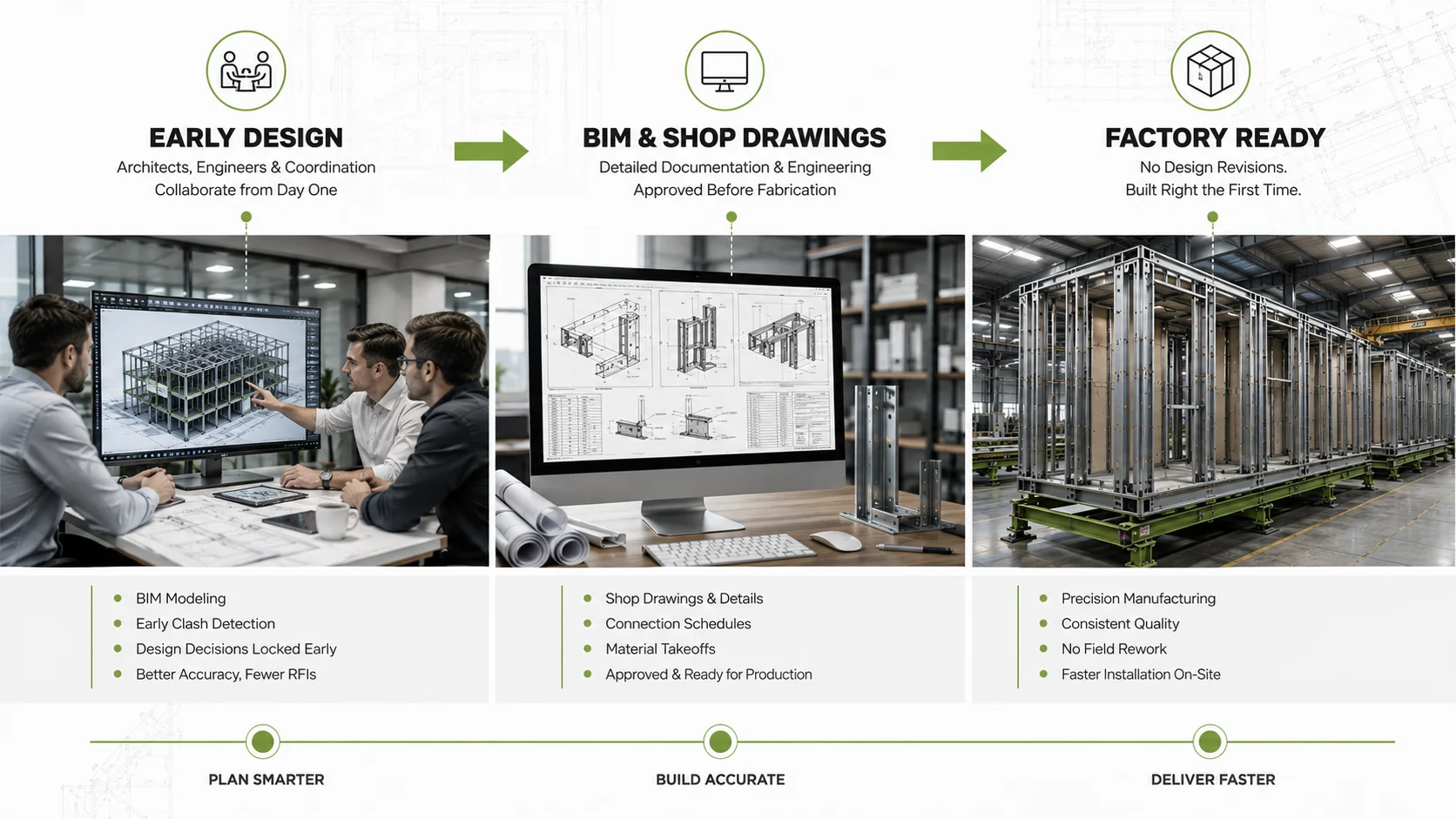
In a conventional build, a lot of detail gets worked out during construction — an RFI here, a field adjustment there. Modular flips that. Because units are manufactured off-site, nearly every dimension, connection, and material choice has to be locked down before fabrication starts. That means architects, structural engineers, and coordination teams like ours are now having conversations in month two of a project that used to happen in month eight. It’s a real shift in how design teams operate, and it rewards firms that can produce accurate, buildable shop drawings early rather than “design as you go.”
Procurement Timing Has Flipped
Traditionally, structural framing gets ordered once the foundation is in and the site is ready. With modular CFS construction, framing production often starts in parallel with site work — sometimes before the first concrete pour. Developers who’ve adjusted their procurement schedules to take advantage of this are seeing real time savings. Developers who haven’t often end up with finished modules sitting in a yard, waiting on a site that isn’t ready — which defeats the purpose entirely.

The Market Is Backing This Up
This isn’t just anecdotal. Industry estimates put the global modular construction market in the $110–125 billion range as of this year, and most forecasts project it will grow at a high-single-digit rate annually through the early 2030s. Steel-framed modules make up the majority of new permanent modular projects, largely because cold-formed steel holds its dimensional accuracy through manufacturing, transport, and installation in a way that timber struggles to match at scale. For a deeper look at why CFS specifically has become the backbone material of this shift, we covered it in our guide to cold-formed steel.
Roles on the Project Team Are Shifting Too
General contractors are increasingly acting as integrators rather than builders in the traditional sense — managing the interface between factory production, logistics, and site assembly rather than swinging every hammer themselves. That’s not a smaller role; it’s a different one, and it requires a different kind of coordination support. Structural engineers of record are leaning harder on manufacturing-grade coordination partners to translate their designs into fabrication-ready packages, because the margin for error shrinks once a module has already left the factory floor.
Insurance and Financing Are Catching Up
One thing we’ve noticed on recent projects: lenders and insurers are getting more comfortable underwriting modular builds than they were even three or four years ago, partly because there’s now a track record of completed projects to point to. That’s removed one of the bigger friction points that used to slow modular adoption down, particularly for mid-rise residential and hospitality developments.
Where This Leaves Developers
If you’re planning a project right now, the practical takeaway is this: modular construction rewards early commitment. The teams getting the most out of it are locking in their structural engineering and coordination partner before the design is even finished, not after. That’s a different rhythm than a lot of developers are used to, and it’s one reason engineering coordination has become such a central piece of project planning rather than a downstream task handled once permits are in hand.
Where CFS Fits Into the Shift
None of this works without a structural system that can maintain tight tolerances throughout the factory-to-site journey. That’s the role cold-formed steel plays, and it’s why more modular manufacturers are standardizing on CFS wall panels, floor systems, and connection details instead of mixing materials project to project.

At X Steel Frame, we work as the coordination layer between structural design and factory production on modular projects — developing the shop drawings, connection schedules, and tolerance documentation that let modules go from the plant to the site without surprises. If you’re weighing whether modular makes sense for an upcoming project, our modular engineering coordination team can walk through what the schedule and structural approach would actually look like for your specific building type.
The building industry doesn’t change overnight, but this particular shift has real momentum behind it — and the projects moving fastest right now are the ones that treated modular as a planning decision, not just a construction method.
