
“Faster” is the word that comes up first in almost every conversation about modular construction, and it’s usually true, but it’s also the part of the pitch developers should scrutinize most carefully, because the speed benefit isn’t automatic. It comes from a specific set of mechanisms, and if any of them break down, the schedule advantage shrinks fast. Here’s where the real time savings come from, and what it actually takes to capture them.
Parallel Work Is the Foundation of the Speed Advantage
The core mechanism behind modular’s speed benefit is straightforward: factory production of modules and on-site preparation work happen at the same time, instead of one after the other. In a conventional build, structural framing generally can’t start in earnest until the foundation and a fair amount of site work is complete. In modular construction, module fabrication can begin as soon as the design is finalized, running in parallel with grading, foundation work, and utility installation. By the time the site is ready to receive modules, a significant portion of the building may already be sitting fabricated and staged.
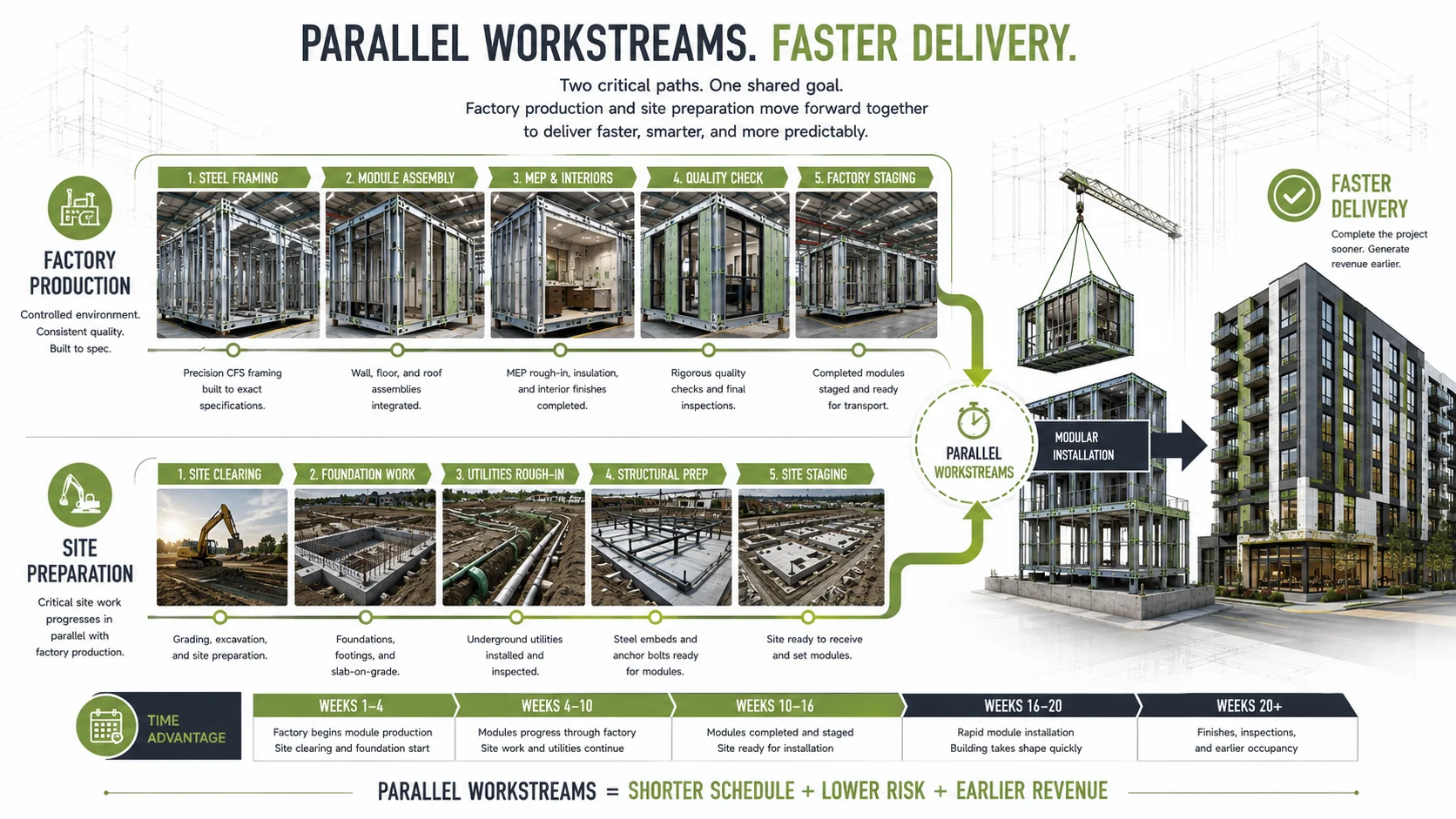
Factory Conditions Remove Weather as a Variable
On-site construction schedules absorb weather delays constantly: rain days, extreme heat slowing crews, wind halting crane operations. Factory production doesn’t carry that same exposure. A module gets built on the same schedule regardless of what’s happening outside, which removes one of the more unpredictable variables from the overall project timeline. This matters more in some regions than others, but in Florida, where hurricane season and daily summer storms are a real scheduling factor, it’s a meaningful advantage.
Quantifying What This Actually Looks Like
On a multi-family project with a large number of repeated units, the time compression can be significant. Where conventional construction might need trade crews sequencing through bathroom construction one at a time across dozens of units- plumbing, tile, fixtures, each stage waiting on the last- modular installation of finished bathroom pods can compress that same scope into a fraction of the time, since installation is largely a matter of positioning and connecting rather than building from scratch on-site. We go into that specific comparison in more detail in how prefabricated bathroom pods reduce construction time.

Where the Speed Advantage Can Quietly Disappear
This is the part that doesn’t get discussed enough. If the interface engineering between modules and the primary structure isn’t precise, on-site adjustment eats directly into the time savings modular was supposed to deliver, sometimes to the point of erasing them. We covered exactly what that engineering discipline requires in factory to site: the role of engineering in modular construction. The honest version of the modular speed pitch has to include this caveat: the schedule gain is real, but it depends entirely on coordination happening correctly before fabrication, not after.

Reduced On-Site Trade Density Speeds Up Sequencing
One underappreciated speed benefit: when kitchen, bathroom, and mechanical modules arrive largely complete, the number of trade crews that need to be sequenced on-site drops significantly. Fewer trades competing for the same floor space and access points at the same time means less scheduling friction, which compounds with the direct fabrication time savings to compress the overall schedule further.
What Faster Delivery Is Actually Worth
For developers, the value of schedule compression isn’t abstract, it’s measured in financing cost, in earlier lease-up or sales revenue, and in getting ahead of competing product coming to market. On mid-rise residential projects specifically, where unit repetition is high and the modular efficiency gains compound across every identical unit, the schedule advantage tends to be most pronounced. We covered how this plays out for that building type specifically in our broader mid-rise resources, and our mid-rise building coordination services are built around capturing exactly this kind of repeated-unit efficiency.
Getting the Speed Advantage Without the Risk
The developers who get the most out of modular construction treat the engineering coordination as the thing that protects the schedule, not as overhead that slows it down. That mindset shift, coordination as a schedule-protection tool rather than a delay- tends to be the difference between a modular project that delivers on its speed promise and one that quietly loses the advantage to field rework.
X Steel Frame’s modular engineering coordination services are built around exactly that principle: getting the interface engineering right before fabrication so the speed advantage modular construction is supposed to deliver actually shows up on the finished schedule, not just the projected one.
Faster delivery is real with modular construction. It’s just not automatic, it’s earned through the coordination work that happens before anyone sees a module arrive on a truck.
