Every developer wants a faster schedule and a building that doesn’t cost them money in year six. Those two goals don’t always point in the same direction; cutting corners for speed usually shows up later as a durability problem. Steel framing is one of the rare cases where speed and long-term performance actually reinforce each other instead of trading off. Here’s why that’s true, and where the actual time savings come from on a real job site.
The Speed Advantage Starts Before the Crew Shows Up
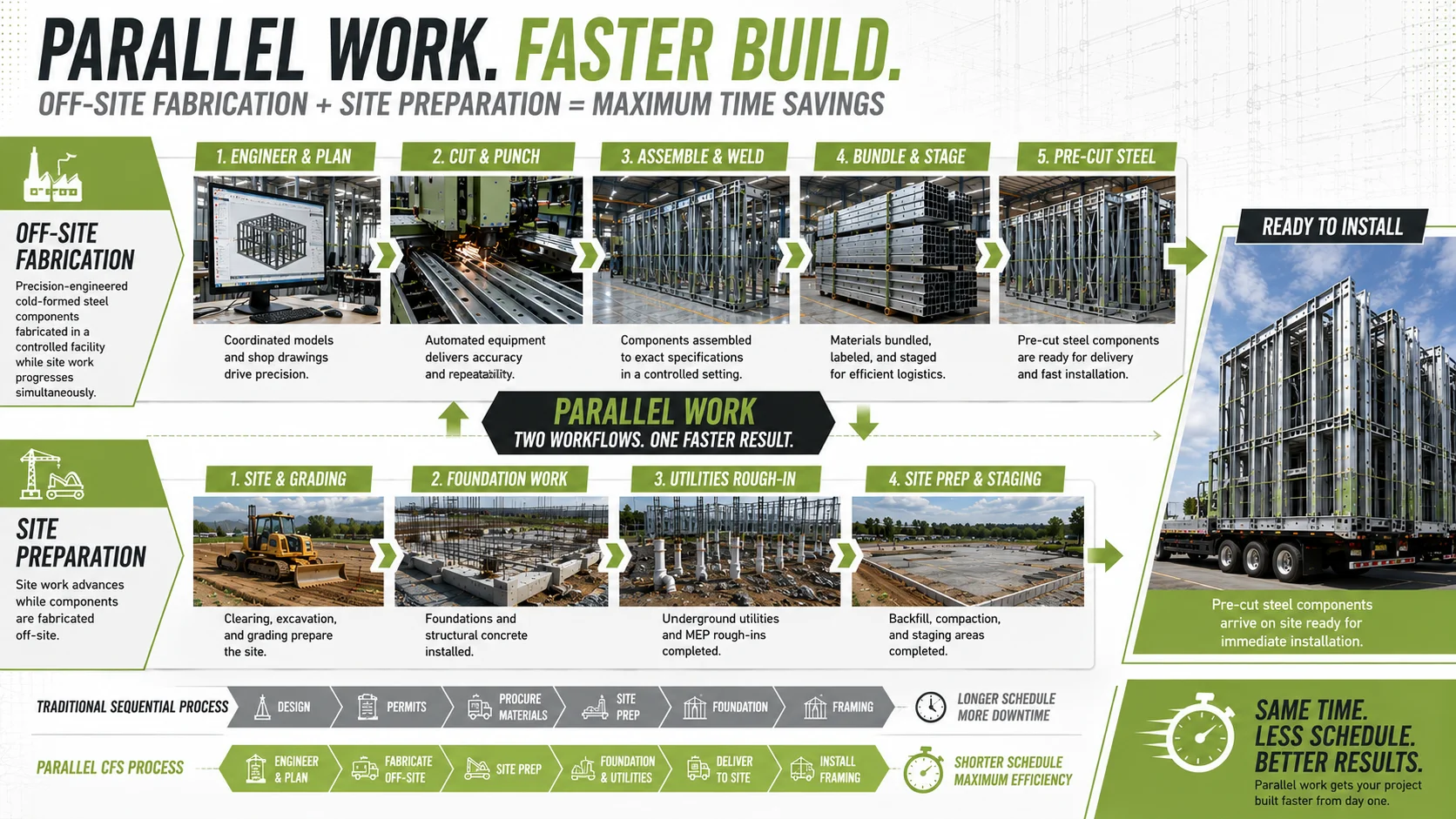
The biggest misconception about steel framing speed is that it’s about installation alone. In reality, a large share of the time savings happens before anyone picks up a screw gun. Cold-formed steel members are cut, punched, and fabricated to spec in a factory while site work, grading, foundations, and utility rough-in is still happening in parallel. By the time the structure is ready for framing, the material has often already been sitting fabricated and staged, rather than being ordered, delivered, and processed on-site the way lumber typically is.
Panelization Compounds the Gain
For larger projects, framing gets pushed further off-site through panelization, with entire wall sections or floor assemblies built in a controlled shop environment and craned into place. What would take a framing crew days to build stick by stick can go up in a matter of hours once the panels arrive. We’ve seen this shave weeks off framing schedules on mid-rise projects specifically, which is one reason panelized CFS has become common in the mid-rise residential space.

Less Rework Means Fewer Schedule Interruptions
Speed isn’t just about how fast material goes up; it’s about how often work has to stop and get redone. Wood framing that’s slightly out of tolerance often gets “fixed” in the field, which eats time and introduces inconsistency. Steel members that are cut to spec in a factory, paired with a coordinated shop drawing package, tend to fit right the first time. That reduces the stop-start rhythm that drags out a lot of conventional framing schedules.
Durability Isn’t Just a Long-Term Story; It Protects the Schedule Too
Here’s the part that often gets missed: durability issues don’t only show up years later. Wood that absorbs moisture on-site before it’s enclosed can warp during construction itself, forcing replacement of members that were already installed. Steel simply doesn’t have that failure mode. It goes up, it stays put, and it doesn’t need to be re-checked for moisture damage before drywall goes on. That protects the schedule in the near term, not just the building in the long term.
Where the Long-Term Payoff Comes From
Once the building is occupied, steel framing’s durability advantage compounds. No shrinkage means fewer nail pops and drywall cracks in the first year. No rot or pest vulnerability means the structural system isn’t quietly degrading behind the finishes. In Florida specifically, where humidity and storm exposure are constant factors, that durability profile has real insurance and maintenance implications over a building’s life, something we touched on in why steel framing is becoming the industry’s default choice.
Speed and Durability Both Depend on the Coordination Behind the Framing.
None of this happens automatically just because a project specifies steel. The speed and durability advantages are only fully realized when the engineering coordination behind the framing is tight, including accurate shop drawings, connection details that match actual field conditions, and a fabrication package that doesn’t leave gaps for the field crew to interpret. A rushed or incomplete coordination process can erase a lot of steel’s speed advantage, because field fixes slow a steel job down just as much as a wood one.

That’s the piece X Steel Frame focuses on. Our engineering coordination services are built to make sure the fabrication package matches the field, so the speed and durability advantages steel framing is supposed to deliver actually show up on your schedule and your balance sheet. For developments where compressed timelines matter most—multi-story residential, hospitality, and mixed-use—our mid-rise building coordination team works specifically on getting panelized and modular CFS systems moving faster from design through installation.
A faster building that falls apart in ten years isn’t actually a win. Steel framing is one of the few structural choices where you don’t have to pick one or the other.
