
Every general contractor who’s run a hotel or multi-family project has a bathroom-scheduling story, and it’s usually not a good one. Plumbing rough-in, waterproofing, tile, fixture installation, and punch-list corrections are all sequenced, one trade after another, sometimes stretched across a week or more per bathroom once you factor in inspections and callbacks. Multiply that by a hundred or two hundred units, and bathroom construction quietly becomes one of the longest, most trade-dependent stretches of the entire schedule. Bathroom pods change the math on this more dramatically than almost any other single construction decision available to a developer.
Why Conventional Bathroom Construction Takes So Long
The core problem with on-site bathroom construction isn’t any single trade being slow; it’s the sequencing. Rough plumbing and electrical have to be roughed in and inspected before the floor substrate goes down. Waterproofing has to cure before tile goes up. Wall tile generally follows floor tile. Fixtures and fittings come last, after finishes are protected. Each stage genuinely depends on the one before it, and each one typically involves a different trade crew that has to be scheduled and coordinated. Across dozens of units built roughly in parallel, that sequencing becomes a scheduling puzzle that consumes real time even when every individual trade is working efficiently.
How Pods Convert Sequential Work Into Parallel Work
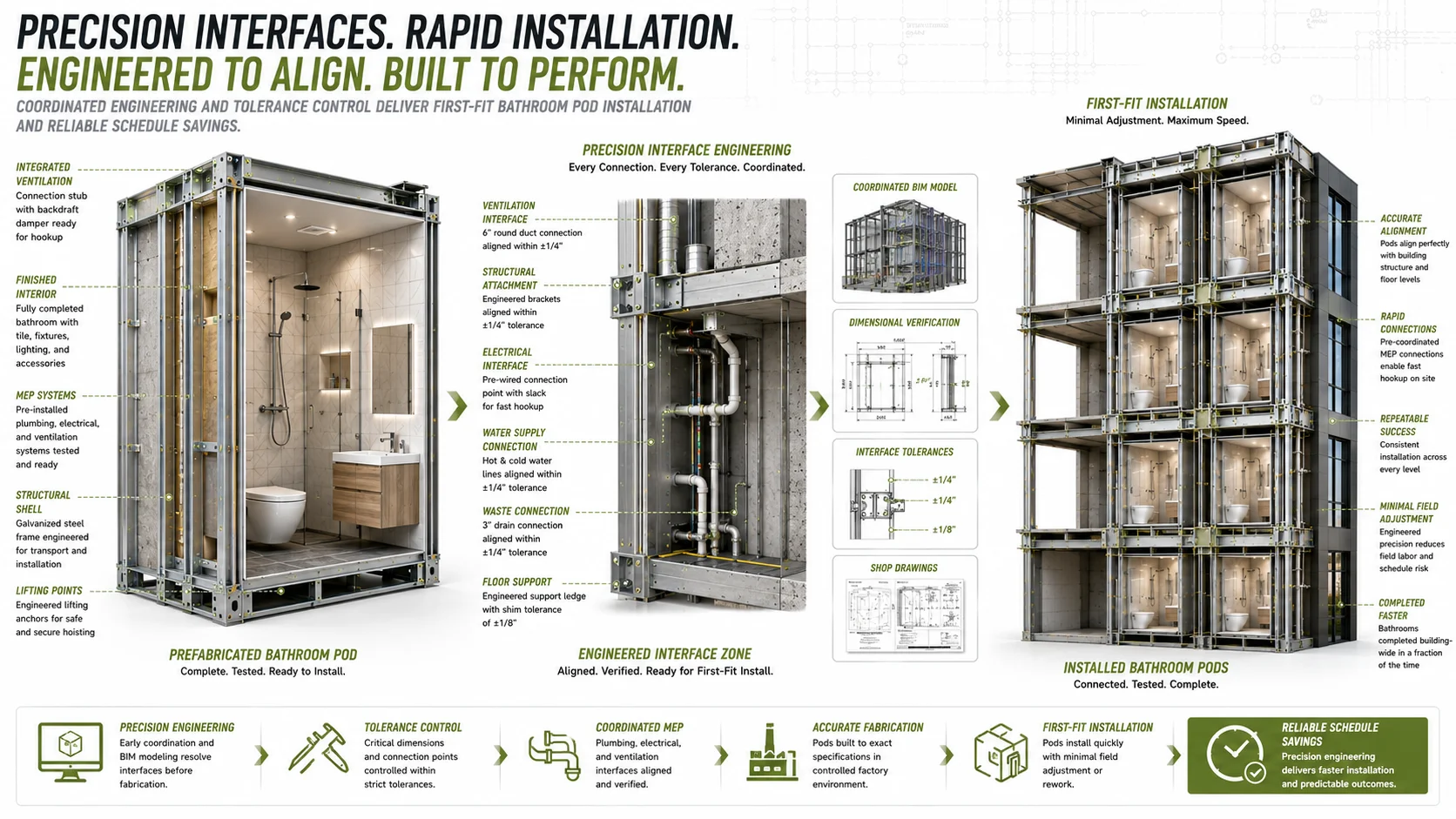
A bathroom pod takes that entire sequence and moves it into a factory, where it stops being sequential in the way that matters for site scheduling. All the trades work simultaneously on multiple pods on a production line, not competing for the same physical space the way they would on an active floor. By the time a pod arrives on-site, all of that sequential trade work is already done; installation is a matter of craning the finished pod into position and connecting it to the building’s plumbing, electrical, and ventilation stub-outs.

Putting Real Numbers on the Comparison
The scale of the difference becomes clear on a larger project. Conventional bathroom construction might realistically require somewhere in the range of a week to ten days of cumulative trade work per bathroom, even when multiple bathrooms are being worked simultaneously by different crews. A finished bathroom pod, by contrast, typically installs and connects in a matter of hours, often two to four hours per unit once the crane and installation crew are working efficiently. Across a two-hundred-unit building, that difference can compress what might otherwise be eight to twelve weeks of staggered bathroom completion into two or three weeks of installation, with no variation in quality between the first unit and the last.
Why This Time Savings Is More Reliable Than It Sounds
A fair question is whether that time savings is consistent or just a best-case scenario. The honest answer is that it depends heavily on the interface engineering between the pod and the building structure. When connection points for water, waste, and power line up precisely with the building’s rough-in locations, installation genuinely is that fast. When they don’t, crews end up making field adjustments that eat directly into the time savings pods are supposed to deliver. This is why pod engineering tends to focus so heavily on tolerance and connection-point precision; it’s not a design nicety; it’s what determines whether the time savings actually materialize on-site. We cover this broader engineering dependency in the benefits of modular construction for faster project delivery.

The Parallel Production Advantage Compounds the Savings
There’s a second time benefit that’s easy to overlook: pods can be manufactured while the building’s foundation and lower floors are still under construction. By the time the structure reaches the floors where pods need to be installed, a substantial portion of the building’s total pod inventory may already be built and staged for delivery, meaning the schedule compression isn’t just about installation speed; it’s also about how much production work happened in parallel with site construction rather than after it.
Beyond Bathrooms: The Same Logic Applies Elsewhere
The scheduling principle behind bathroom pods, moving repetitive, trade-dense work into a factory to convert it from sequential to parallel, applies to other building components too, including kitchen pods and mechanical plant modules. For developers focused on compressing schedules across an entire project, bathroom pods are often the clearest starting point, but rarely the only opportunity.
What This Means for Planning Your Next Project
The time savings from bathroom pods are real and well-documented across completed projects, but capturing them fully depends on planning for pods early enough that unit layouts and rough-in locations are designed around the pod’s requirements from the start, not retrofitted later. We go deeper into where this technology is headed and how developers are adopting it earlier in project planning in bathroom pods: the future of fast and efficient construction.
X Steel Frame’s bathroom pod engineering coordination services focus specifically on the interface precision that makes this time savings dependable rather than aspirational, and our mid-rise building coordination team works with pod strategy from the earliest stages of unit layout planning.
Two to four hours versus a week and a half, repeated across every bathroom in the building—that’s not a marginal improvement. It’s one of the clearest schedule wins available in modern residential and hospitality construction, as long as the engineering behind it holds up.
