Nobody sets out to build a non-compliant structure. Almost every code violation we’ve seen traced back to its source wasn’t a case of someone cutting corners on purpose—it was a coordination gap. A detail that got assumed instead of specified, a load case that got missed, an approval that got overlooked because nobody was tracking it systematically. The good news is that because these mistakes are process failures rather than knowledge failures, they’re genuinely preventable. Here’s where they tend to come from and what actually stops them.
The Real Cost Isn’t the Fine — It’s the Stoppage
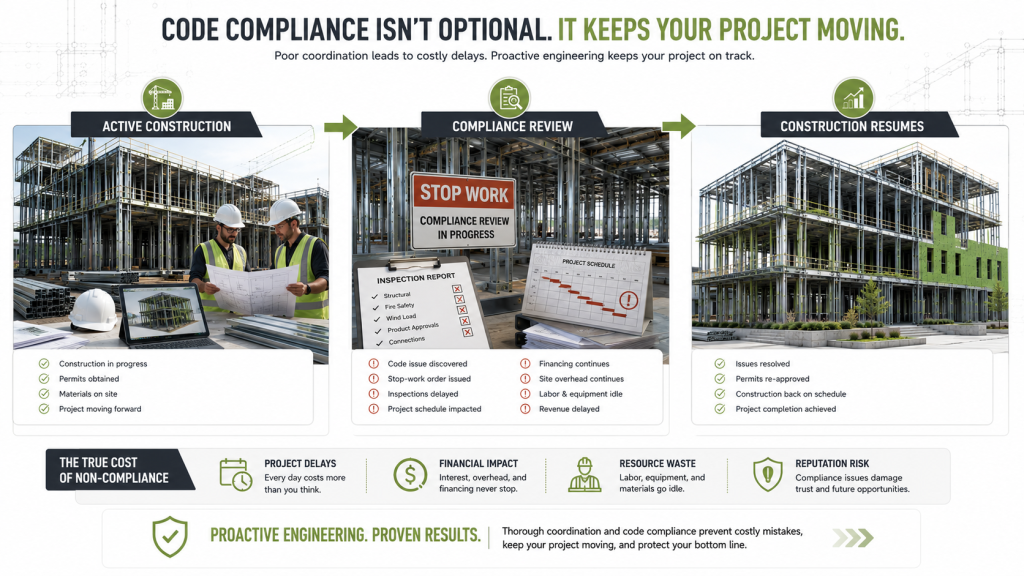
When people think about code violations, they usually picture a fine or a warning letter. On an active construction project, the actual cost is almost always the stop-work order. Construction financing keeps accruing interest whether or not crews are on-site. Site overhead—trailers, security, equipment rental—doesn’t pause just because a compliance issue is being resolved. And every week of delay pushes back the date a developer starts generating revenue from the completed building. A mid-rise or commercial project can lose far more to a two-week stoppage than it would have spent on thorough coordination in the first place.
Mistake #1: Connection Design That Doesn’t Cover the Full Load Combination
This is the most common serious issue we see. A connection gets designed for gravity loads but doesn’t fully account for wind uplift acting in combination with other forces—which matters enormously in Florida, where HVHZ wind requirements are a real design driver, not a formality. The fix isn’t complicated engineering; it’s making sure every applicable load combination is checked before the connection schedule gets finalized, not assumed to be “close enough” based on a similar past project.
Mistake #2: Missing or Outdated Product Approvals
In HVHZ jurisdictions specifically, structural components need current Florida product approval or Miami-Dade NOA documentation. We’ve seen projects get held up not because a product was wrong, but because the approval paperwork on file had lapsed or didn’t match the exact product configuration being installed. This is a documentation problem more than an engineering one, but it stops a job just as effectively. It needs to be tracked actively throughout the project, not checked once at the start.
Mistake #3: Fire-Rated Assembly Details That Drift From Spec
A fire rating is only as good as the exact assembly it was tested with—specific drywall thickness, specific fastener spacing, and specific fire-stopping materials. Small field substitutions that seem harmless, like a slightly different screw pattern, can technically invalidate the rating. This is one of the more frustrating mistakes to catch late because the wall often looks correct—the deviation isn’t visible without checking it against the tested assembly documentation.
Mistake #4: Structural Members Selected Without Full Analysis
Undersizing happens most often when a member gets selected based on a rule of thumb or a similar past project rather than a full analysis of the specific load combinations on this project. CFS design has to account for gravity loads, wind loads, deflection limits, and stability requirements together—skipping the full analysis to save design time almost always costs more later, either in rework or in a compliance flag at inspection.
What Actually Prevents These
Every one of these mistakes has the same underlying fix: systematic, proactive coordination rather than reactive checking. That means code review happens at each design stage rather than once at the end, product approvals are verified against the exact specified components rather than assumed, fire-rated assemblies are documented in detail before installation begins, and structural analysis covers every applicable load case rather than the obvious ones. We laid out what a proactive coordination process looks like more broadly in our guide to code-aware structural systems, and the HVHZ-specific requirements are covered in our article on meeting HVHZ and life-safety codes.

The Economics Are Straightforward
Comprehensive engineering coordination costs a small fraction of what a single serious compliance failure costs on a mid-rise or commercial project. This isn’t really a judgment call—it’s a fairly simple comparison once you’ve seen both sides of it. Developers and contractors who’ve been through a costly compliance stoppage once rarely need convincing on the next project.
At X Steel Frame, avoiding these exact mistakes is the core of what our code-aware engineering services are built around — systematic tracking of load cases, product approvals, and fire-rated assembly details from the earliest design stages. For developers who want a dedicated partner managing this across the full project lifecycle, our technical project partner services extend that same discipline through construction and final inspection.
The mistakes covered here aren’t rare edge cases—they’re the same handful of issues that show up on project after project. Which also means they’re the same handful of issues that a coordinated process reliably catches before they cost you anything.
