
Ask ten people on a construction project what “engineering coordination” actually means, and you’ll probably get ten slightly different answers. It’s one of those terms that shows up in scopes of work and proposals constantly, but the actual function it serves on a project is easy to underestimate until you’ve worked on a job that didn’t have it done well. Once you have, you notice its absence immediately on the next one.
It’s the layer between the drawing and the building.
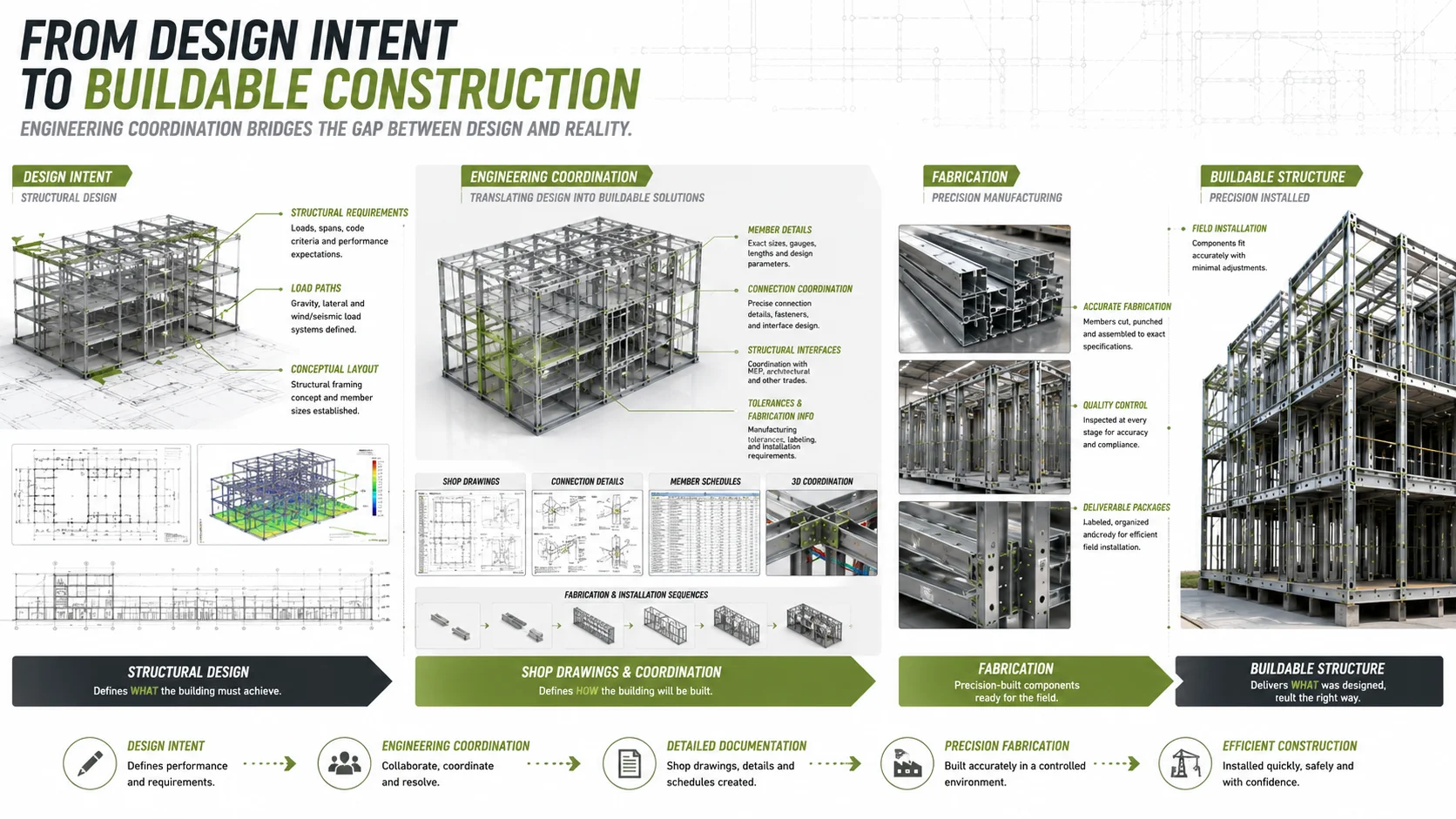
A structural engineer’s drawings tell you what the building needs to do, the loads it has to carry, the spans it has to achieve, and the code it has to satisfy. What they usually don’t tell you is exactly how every stud, track, and connection gets fabricated, labeled, and installed in the field. That translation, from engineering intent to buildable reality, is what engineering coordination actually is. It’s not a formality tacked onto the structural design; it’s the step that makes the structural design constructible.
Why This Role Has Grown So Much
Twenty years ago, a lot of this translation work happened informally, a foreman working it out with a superintendent on-site, adjusting as they went. That approach doesn’t hold up anymore, for a few reasons. Buildings are more complex, with tighter MEP integration and more demanding facade systems. Code requirements, especially in places like Florida with HVHZ and life-safety provisions, leave less room for field improvisation. And project schedules are tighter, which means there’s less time available to work problems out after the fact. Engineering coordination absorbs that complexity before it reaches the site, which is exactly where you want it absorbed.
What the Work Actually Involves
On a typical cold-formed steel project, engineering coordination means developing detailed shop drawings for every structural member, building out connection schedules that specify exact fasteners and spacing, running clash detection against MEP and architectural models, and tracking code compliance requirements against the structural design as it develops. We laid out the full scope of this process in our earlier look at engineering coordination in CFS construction, but the short version is it’s detailed, it’s document-heavy, and it’s easy to shortcut if a project is trying to save time or money in the wrong place.
What Happens When It’s Skipped
We’ve seen the version of this that goes wrong. A framing package that’s technically structurally sound on paper but doesn’t account for a mechanical chase running through a load-bearing wall. The connection details were left vague enough that three different crews interpret them in three different ways. Code item failures—they’re the kind of quiet, expensive delays that eat into a project’s schedule and budget a little at a time, and they’re almost always traceable back to coordination that happened too late or too loosely.
Who Actually Owns This Role
This is where it gets a little murky on a lot of projects. Structural engineers are focused on design, not fabrication detail. General contractors are focused on sequencing and means and methods, not structural connection design. Fabricators need direction, not authorship. Engineering coordination has increasingly become its own specialized function precisely because it doesn’t naturally belong to any of those other roles; it requires someone dedicated to sitting at the intersection of design intent, code compliance, and buildability. That’s part of why the idea of a dedicated technical project partner has gained traction on more complex projects.
Where This Is Heading
As projects lean further into modular and panelized construction, the margin for coordination error keeps shrinking. You can’t field-fix a module that’s already left the factory the way you might adjust a wall that’s still being framed on-site. That trend is pushing engineering coordination even earlier into the project timeline, not a step that happens after design is “done,” but one that runs in parallel with it from the start.

At X Steel Frame, this is the entire reason we exist as a firm. Our engineering coordination services sit at exactly that intersection, translating structural design into fabrication-ready, code-compliant packages that hold up in the field, not just on paper. For projects with demanding regulatory requirements, our code-aware coordination team builds compliance into that process from day one rather than checking for it afterward.
Engineering coordination doesn’t show up in the finished building’s photos. But talk to anyone who’s run a project without it, and they’ll tell you exactly where it was missing.
