
Ask a builder who’s poured concrete on both wood-framed and steel-framed jobs which one they’d choose again, and you’ll usually get a fast answer. It’s rarely about brand loyalty to a material—it’s about what happened on the last project. Late deliveries, warped studs, and a framing crew standing around waiting on lumber that didn’t show up straight. Steel framing solves problems builders have actually lived through, and that’s really the whole story behind its growth. Here are the five reasons that come up most often when we talk to contractors on-site.
1. What Arrives Is What Gets Installed
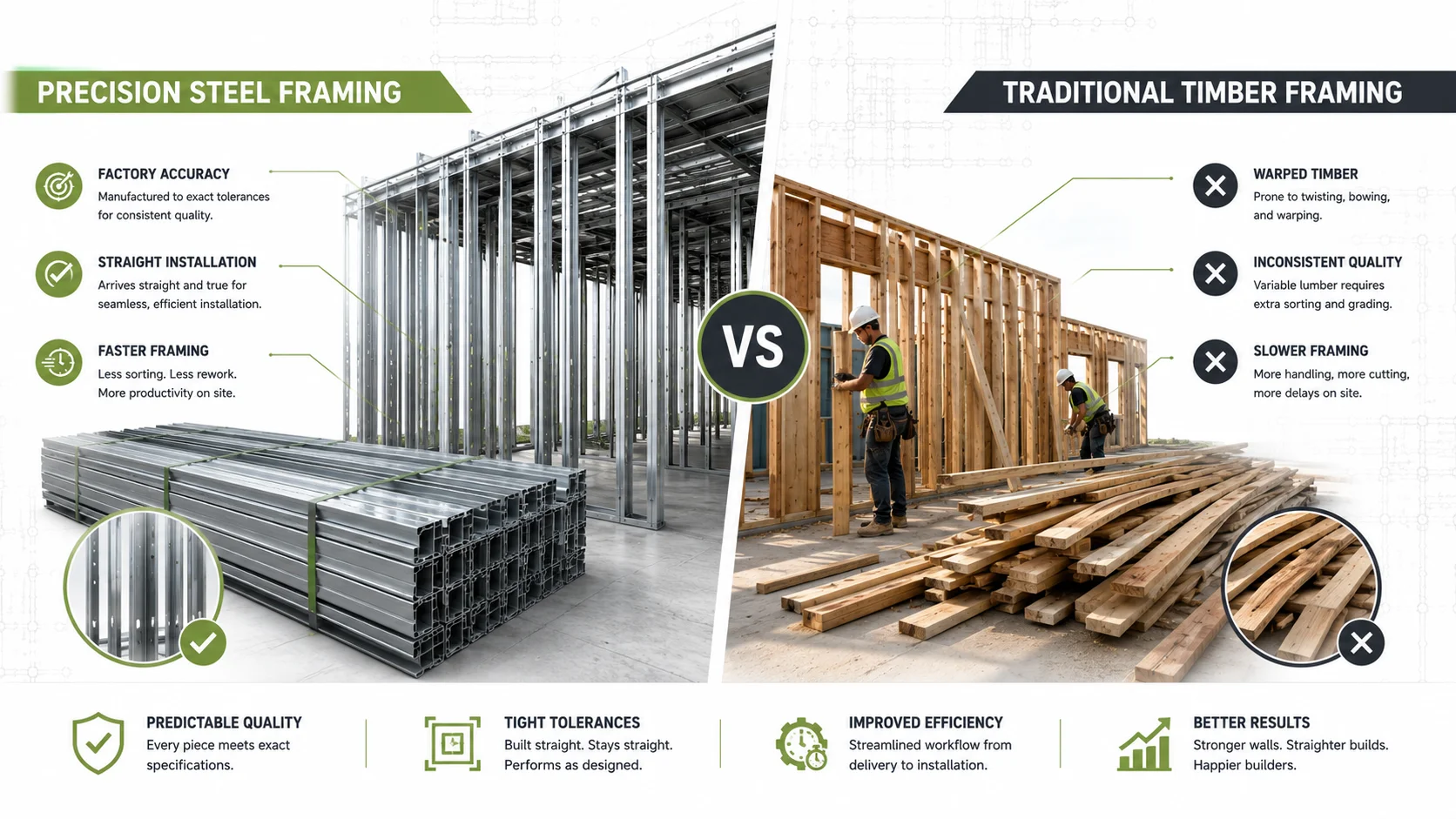
This sounds simple, but it’s the number one thing builders mention. A steel stud that leaves the factory at a certain length and gauge arrives at the site the same way. It doesn’t twist in humidity, it doesn’t need to be culled for defects, and a crew doesn’t have to sort through a bundle looking for the straight ones. For a superintendent trying to hold a schedule, that predictability alone is worth a lot.
2. Framing Crews Move Faster With Fewer People
Because CFS members are lightweight relative to their strength, a smaller crew can handle material that would otherwise require more hands or mechanical lifting. Screw guns replace a lot of the cutting and fitting that eat up labor hours in timber framing. On a comparable wall run, builders consistently tell us steel framing crews move through layout and assembly faster once they’re past the initial learning curve.
3. Fewer Callbacks After Substantial Completion
Timber framing that looked fine at inspection can still move—shrinking, cupping, or checking as it dries out over the following year, sometimes telegraphing through drywall seams or causing doors to stick. Builders who’ve dealt with post-completion callbacks tied to wood movement tend to be the strongest converts to steel, because CFS doesn’t go through that drying process at all. What’s installed plumb and square tends to stay that way.

4. It Simplifies the Inspection Conversation
Building department inspectors are increasingly familiar with CFS assemblies. Because cold-formed steel design follows well-documented standards like AISI S100, structural submittals tend to move through review with fewer questions when the engineering package is complete and clearly detailed. We go deeper on the code side of this in our HVHZ and Florida Building Code compliance guide, but the short version is that a well-coordinated CFS package tends to create fewer back-and-forths at plan check.
5. It Holds Up in Florida’s Climate Without Extra Steps
This one is specific to builders working in coastal and high-humidity markets. Wood framing in Florida often needs pressure treatment, moisture barriers, and ongoing pest monitoring to hold its structural integrity. Steel framing simply doesn’t have that vulnerability—no termites, no rot, no swelling. For builders who’ve dealt with a termite inspection holding up a closing, that’s not a minor convenience.
It’s Not Just About the Material — It’s About the Coordination Behind It
Here’s the part that doesn’t get talked about enough: steel framing only delivers on these advantages when the shop drawings and connection details are right before fabrication starts. A builder who gets a rushed or incomplete coordination package ends up dealing with field fit issues anyway, which can sour a crew on steel framing that wasn’t really the material’s fault. We wrote more about what separates well-coordinated CFS projects from problem ones in “Why Builders Prefer CFS Engineering for Modern Structures.

At X Steel Frame, our job is to make sure builders actually get the advantages steel framing is supposed to deliver—accurate shop drawings, connection schedules that match real field conditions, and a coordination process that catches conflicts before they reach the job site. If your crews are new to CFS or you’ve had a rough experience with an under-coordinated project in the past, our technical project partner services are built specifically to close that gap. And for projects where LGS and CFS systems need to work together across interior and structural applications, our LGS/CFS specialization team can help scope the right system from the start.
Builders don’t switch materials because of a brochure. They switched because something on a past job went wrong, and steel framing removed that variable. That’s really the whole explanation for why it keeps winning ground on new projects.
